Cognition-driven dual-graph fusion with group-level mastery for knowledge tracing
We added CGMKT into our pyKT package.
The link is here and the API is here.
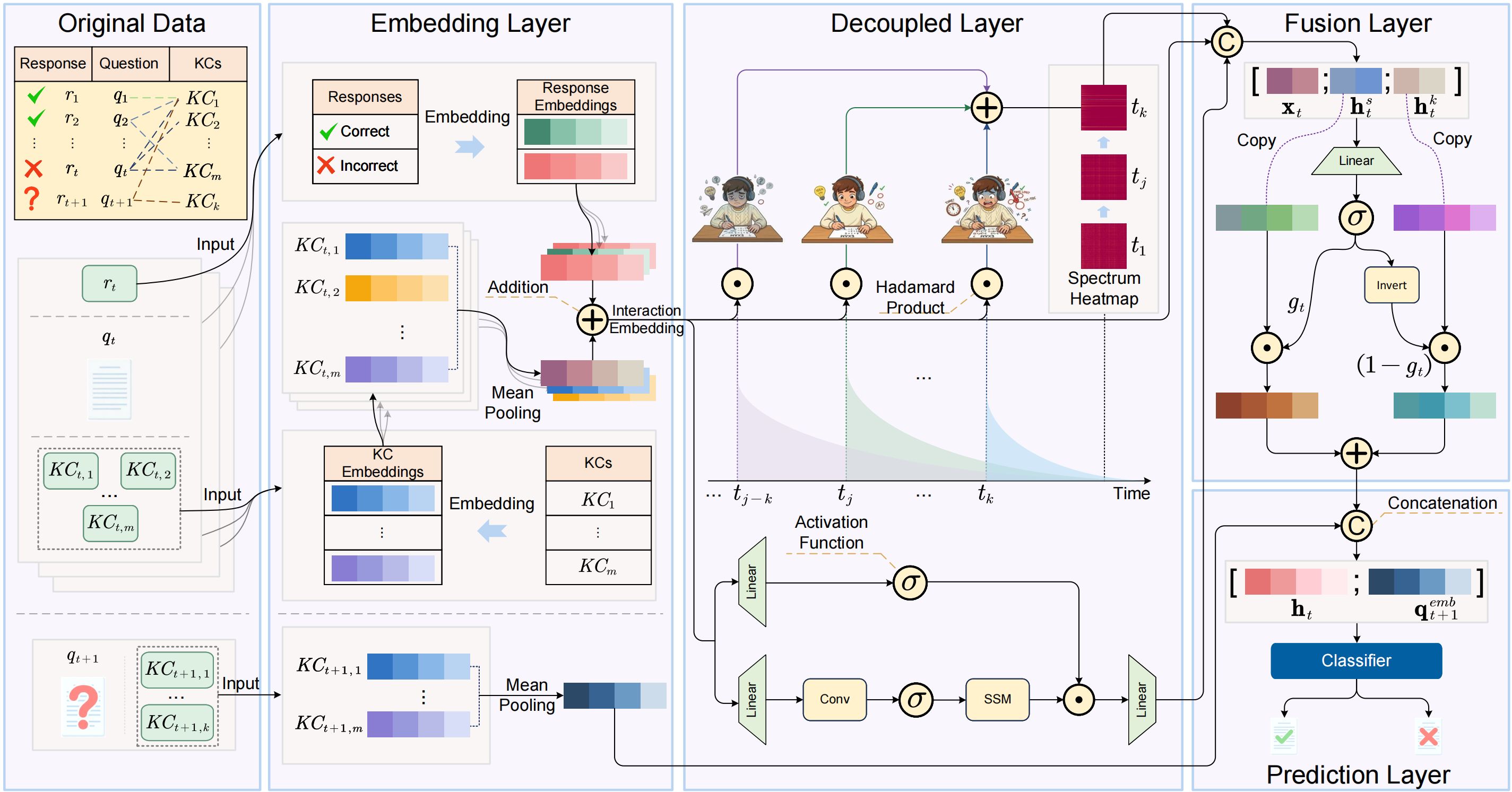
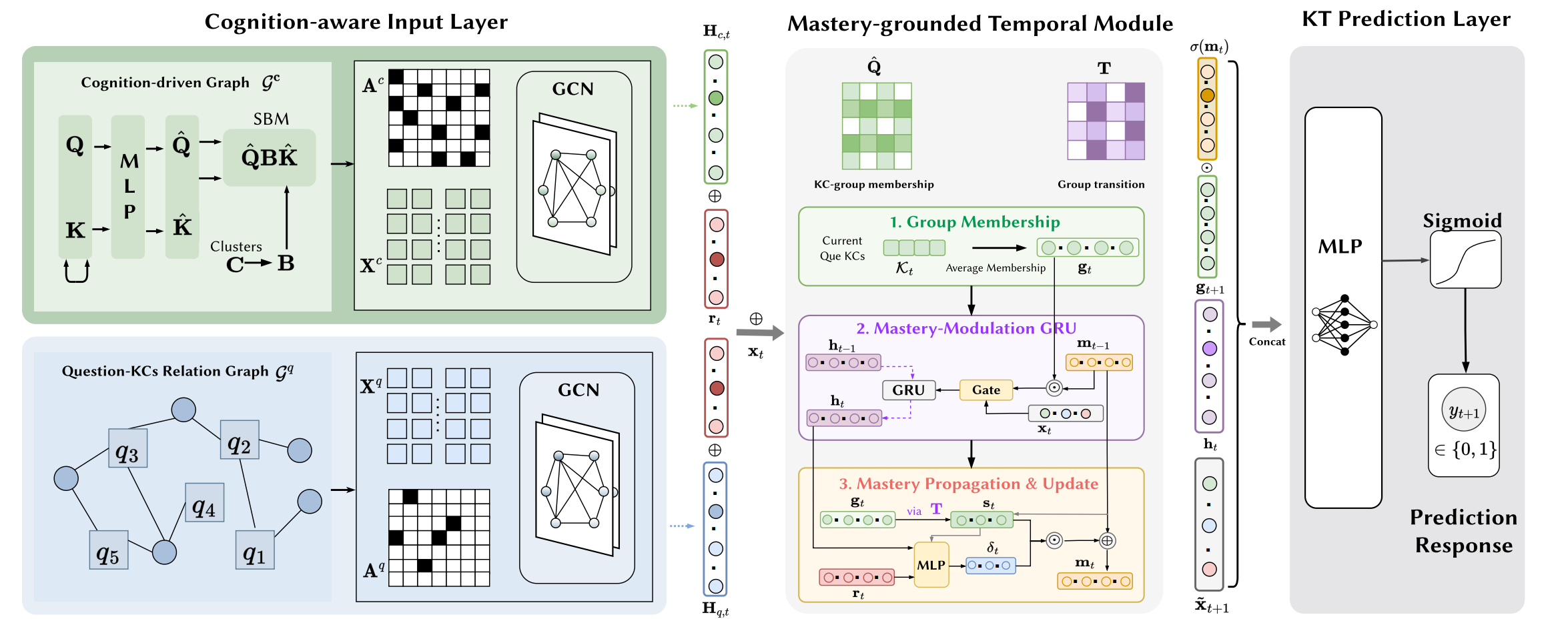
Knowledge tracing (KT) predicts students’ future performance from their historical interactions and is a key component of intelligent tutoring systems. Behind KT lies the modeling of cognitive development, which unfolds through two mechanisms: students integrate new content into existing knowledge structures (assimilation) while developing individually distinct learning trajectories (differentiation). Current deep KT methods capture neither mechanism well: they represent knowledge component relations homogeneously, and they encode each interaction without an explicit, student-specific mastery state. We propose CGMKT (Cognition-driven Graph fusion with group-level Mastery for Knowledge Tracing), which instantiates the two mechanisms as a dual-graph structure and an explicit mastery state. For assimilation, CGMKT fuses a knowledge-component (KC) dependency graph, learned by a stochastic block model that captures heterogeneous intra- and cross-group structure, with a question-question co-occurrence graph induced by question-KC incidence; a learned group transition matrix propagates mastery gains across related groups. For differentiation, CGMKT maintains a group-level mastery state per student and uses it to gate each interaction, so that the same question yields different encodings for students with different mastery histories. Extensive experiments on three public datasets show that CGMKT consistently outperforms 21 baselines. Ablation studies confirm the contribution of each component, and a case study with structural analysis of the learned knowledge groups shows that the mastery state yields individualized, interpretable predictions. Code is available at https://pykt.org/.
Original paper can be found at Youheng Bai et al. “Cognition-driven dual-graph fusion with group-level mastery for knowledge tracing.” Information Fusion, 2026.